

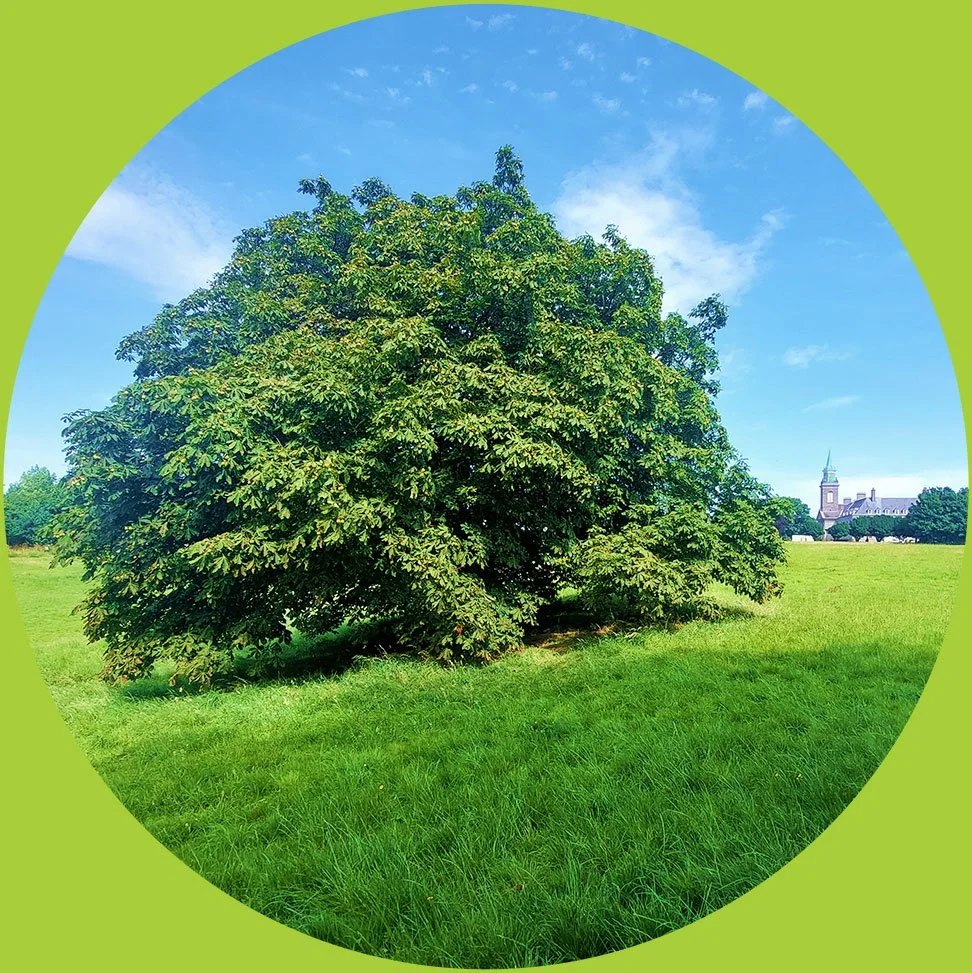

Tree #68 has grown low to the ground, creating an intimate cave-like space with natural acoustic qualities. We captured field recordings in this space of the ambient soundworld of our tree, including bioacoustic recordings — sounds of living species in the vicinity of the space.
We invite you to listen with this tree and immerse yourself in it’s world. The 30 minutes of music compositions below have been created for this project by Jamie Lemoine from our field recordings with Tree #68.
[ Better listening experience with Headphones, if you have them. ]
Horse chestnut — Aesculus hippocastanum — Cnó capaill
Originally native to the mountains of northern Greece and Albania, the Horse Chestnut tree was introduced into Ireland in the early 1600’s.

TREE #68 — APRIL, 2024.
One of three Horse Chestnut trees in the meadow at IMMA near Bully’s Acre. Tree #68 is the only one to grow right down to the ground.
EVERY TREE IS UNIQUE. The grove of three Horse Chestnut trees in the meadow were planted at the same time. They are managed very lightly, without pruning and intervention only if a problem is discovered.

Squirrels like shiny things and carry them away, speculations about why this might be include the possibility that they use them to “decorate” their nests, or to attract a mate.
Squirrels taking away the shiny tree numbering tags at IMMA led to a change of tagging system, Tree #68 still has it’s silver tag (for now) but has a new number #8172.

Simple method for calculating the age of a tree.
The girth of a tree can be used to estimate its age, as roughly a tree will increase it's girth by 2.5cm in a year. Measure around the trunk of the tree (the girth) at about 1 meter from the ground. Measure to the nearest centimetre. Then divide the girth by 2.5 to give an age in years.
Using this method, Tree #68 is 87 years old.
Horse chestnuts (conkers!) are the seeds of the tree, they contain a substance called aesculin that is toxic to humans and many other mammals. They are often confused with edible sweet chestnuts. If consumed, horse chestnuts have a bitter taste and can cause serious digestive problems.

TREE #68, SEED — SEPTEMBER, 2024.
The name Horse chestnut comes from the historical use of horse chestnut seeds to treat coughing in horses. Horse chestnut extract (with toxins removed) is used in alternative medicine to improve blood flow by thinning blood and also to treat bruises.
The Victorians made a mildly poisonous flour from horse chestnuts. The seeds were shelled, ground and then leached to remove the bitter taste.
In England during the Second World War, conkers were ground to make a coffee substitute.
Horse chestnuts are extremely high in saponins and have anti-bacterial properties, when crushed and soaked in boiling water they produce a liquid soap that can be used as a laundry detergent
The spiky casing of the seeds can be used to make ink.

Squirrels do not eat horse chestnuts — aesculin is toxic to them — but they still bury them for unknown reasons. Squirrels strategically bury items in a scattered pattern (called scatter-caching), burying extra amounts to allow for theft by other squirrels. They create a complex mental map of where their hoard is buried.
Squirrel horse chestnut hoarding process:
Inspect the horse chestnut thoroughly first to select a good specimen.
Dig a hole just big enough to fit the chestnut with your front paws.
Push the nut deep into the hole with your mouth and cover it with soil.
Watch out for spies at all times!

-
The horse chestnut leaf miner is the larvae of the moth Cameraria ohridella. The adult moths are just 4-5mm in length. Discovered near Macedonia in the 1980s they rapidly spread across Europe. Travelling at an estimated 60 km per year via windborne moths, or leaves containing the larvae moving around via passive transport or on imported plants. They favour moist summers and mild winters. First identified in Ireland in 2013, horse chestnut leaf miners are now common in Ireland’s white blossoming Horse chestnut trees, their preferred host plant.
After hatching from the egg, the larvae bore into the leaf and feed in the upper tissue layers without damaging the epidermis of the leaf above. In this way, closed cavities are created in the leaf, the so-called "mines". The larvae develop in these mines, protected from external influences. A single tree can host a million leaf‐miners.
Signs of the Horse chestnut leaf miner:
Tracks within the leaves left by the feeding larvae.
Dry, crisp and brown leaves.
Premature leaf drop from the tree
The insects can have 1–4 generations per season, depleting nutrients from the tree and possibly resulting in reduction in the weight of seeds (‘conkers’), but the overall impact on the tree is usually more aesthetic than life-threatening.
Removing and destroying the fallen leaves is the cheapest and most environmentally friendly method for managing horse chestnut leaf miners.
-
Tree wounds are anything that breaks the bark and damages the living tissues of the tree responsible for transporting nutrients. Trees have the ability to protect themselves by sealing their wounds with callus tissue. A healthy tree can repair minor damage over time.
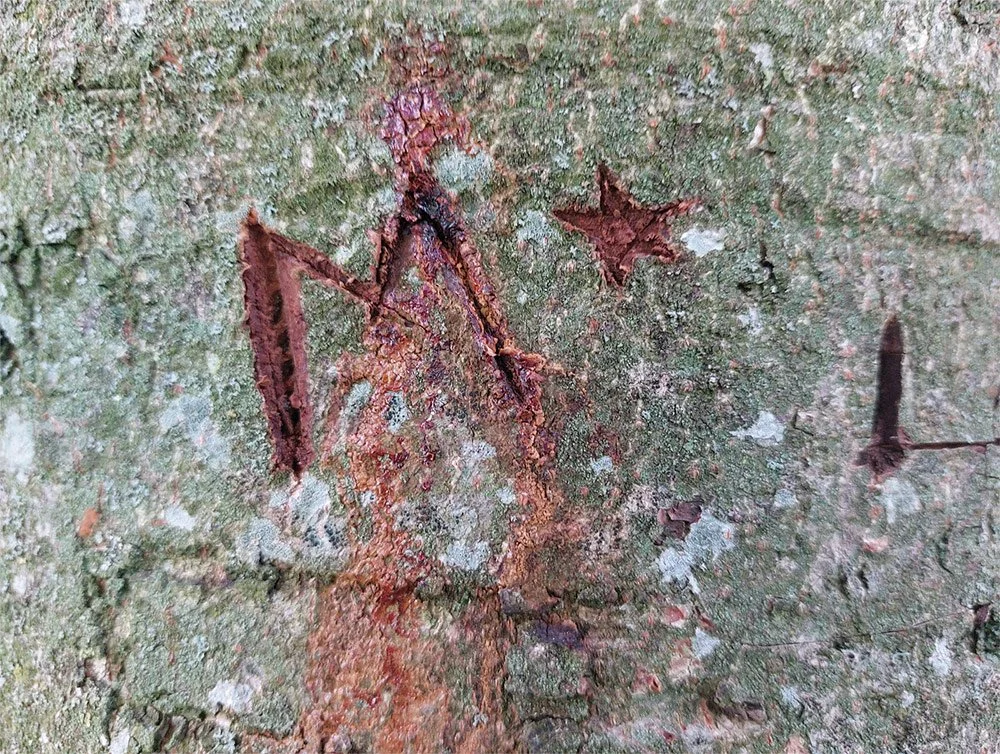
Tree 68 has some intentional wounds caused by humans carving into its' bark.
Some of these open wounds became infected with a bacterium that targets horse chestnut trees, "bleeding canker of the horse chestnut". It infects trees through wounds or naturally-occurring cracks. Infections spread in the living inner bark, provoking the tree to produce a reddish sticky liquid which bleeds out onto the outer bark.
This bacterium is becoming more common in Ireland due to climate change. In the past, cold winters would have killed the pathogen but milder winters are allowing it to thrive. It is the biggest threat to the horse chestnut tree and can result in the death of the tree.

One Horse Chestnut Tree can sequester approximately 0.53 metric tons of carbon per year (carbon sequestration is the removal of carbon dioxide from the air).

Humans are drawn to trees but we can love them to death. If too many of us “crowd” a tree, we can cause the soil under the tree to become compacted.
Tree #68 has signs of soil erosion and soil compaction around its base caused by people.
Soil is made up of mineral particles, organic matter, living organisms, and pore space. This pore space allows water, oxygen, and nutrients to move through the soil easily, creating healthy root systems and a thriving ecosystem. Soil compaction occurs when soil is pressed together, reducing the pore space. When soil is compacted, the water, oxygen, and nutrients can’t penetrate the dense soil, roots are no longer able to spread.
Nettles are often allowed to grow underneath trees to protect them (from us), especially fragile veteran trees.
#DontCrowdTheTree
Signs of Life — Detecting Multi-species Interactions
Visiting and sitting with Tree #68 it was obvious that lots of other beings are drawn to this site and enjoy spending time here. There was plenty of “evidence” under the tree, hidden from view outside in the meadow.


Special thanks to Mary Condon, Head Gardener at IMMA for all her assistance.

Click on the graphic above to view the Grass Project, created by POND Studios for the Sustainable Sculpture Exhibition at Trinity Green Week, 2024.